


 Timing runs through every part of the dementia experience: when a diagnosis arrives, how an older adult living with dementia stays oriented in their daily life, and how caregivers navigate their own sense of time alongside everything else.
This year's World Alzheimer's Month theme, as chosen by Alzheimer's Disease International, is "The Earlier You Know, The More You Can Do." An early diagnosis changes what's possible. It gives the person living with dementia a chance to be part of shaping their own care, and gives caregivers time to understand what's ahead and prepare with more steadiness than urgency.
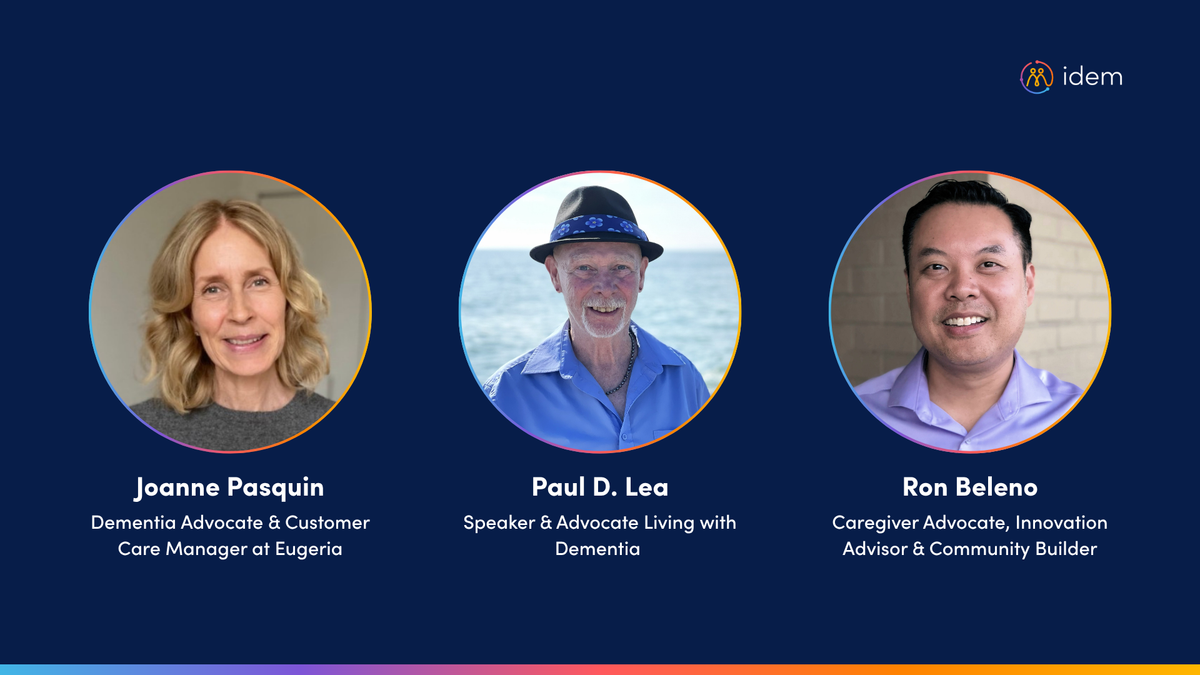
On September 21, 2026, World Alzheimer's Day, Idem held an insightful discussion that brought together Paul D. Lea, an older adult living with dementia, as well as Ron Beleno and Joanne Pasquin, two dementia advocates who cared for their fathers, each sharing what timing has meant in their own journeys.
Together, they discussed:
-
Navigating a Diagnosis: What the early stages of dementia can look and feel like
Gain first-hand perspectives from an older adult living with dementia and caregivers who supported their loved ones on how the initial stages can unfold. -
Staying Anchored in Time: When hours, days, and dates become uncertain
Time shapes how we feel grounded, connected, and present in each day. This conversation explores what it looks like when that begins to shift, and what it means to stay close through it. -
Building a Support System: Tools and strategies that help
From daily routines to assistive tools, discover what has helped someone living with dementia feel more supported, and how to build care systems that truly center them. -
Finding Your Footing: Practical tips to carry into your own journey
Our panelists close with the insights, encouragement, and concrete takeaways they wish they'd had earlier in their journeys.

Watch our latest webinar on “Timing Matters: A Conversation About Early Dementia Diagnosis and the Value of Time”
💡 Key takeaways:1. Early diagnosis opens doors, but readiness is personal 2. What happens after diagnosis matters just as much as the diagnosis itself 3. The right tools give time back to everyone in the care circle |
Navigating a Diagnosis
Paul's path to a dementia diagnosis came through when he had a massive stroke. Six months later, he was diagnosed with vascular dementia. The period that followed was marked by confusion, uncertainty, and panic attacks. Tasks that had once been routine, such as cooking, laundry, shopping, walking, required relearning from the ground up. His daughter was central to that process, spending years patiently guiding him through each step. "If it wasn't for her," Paul said, "life would have been different."
Joanne's experience came from a caregiver perspective. Her father was diagnosed with Alzheimer's in early 2017, but looking back after the fact, she could trace signs to 2015 and 2016. These signs showed up in small things that she had initially explained away, such as a moment of being lost in a familiar neighborhood, confusion about whether dinner was today or tomorrow evening, or a decision that didn't quite make sense. "I just found some other reason why that happened," she said.
A common thread ran through both of their stories. Before they understood what was happening, they had assumed dementia was primarily about memory. It's a misconception that shapes how families recognize, or don't recognize, what's actually happening. As Joanne put it: "All I knew about Alzheimer's was that it was a memory problem, but it's so much more." Judgment, decision-making, time perception, and personality can all shift, often before anyone has a formal diagnosis to point to.
Ron noted that this experience is nearly universal among the thousands of caregivers and families he has spoken with across Canada over the years. When dementia is viewed solely as a memory impairment, key early indicators are easily overlooked, often postponing recognition and diagnosis.
Staying Anchored in Time
A central, deeply moving theme during the discussion was how profoundly time itself is affected by dementia, beyond just remembering appointments and dates. The experience of how time progresses also changes for someone living with dementia.
Joanne described telling her father that dinner at her brother's was the next evening. That afternoon, he was already getting ready to leave. For a while, moments like this happened here and there, and she always found justifications. Instead of merely forgetting a specific detail, these moments reveal a deeper change in how an individual perceives and experiences the passage of time.
In the early years following his diagnosis, even the thought of an upcoming appointment could spark panic for Paul. Because of this, his daughter accompanied him regularly, which, as Paul noted, "took a big chunk out of her life".
Ron described dementia as a broad struggle with time, affecting the duration needed to finish daily tasks, the hours caregivers can claim for themselves, and the gap between receiving a diagnosis and accessing real support. "Our time changes on a daily basis," he explained. "Paul's time would change, from the time he wakes up to the time he goes to sleep."
Though rarely included in formal clinical descriptions, this aspect of dementia fundamentally impacts everyday life in concrete ways.
Building a Support System
Paul and Joanne both discovered on their own that using appropriate support tools completely transformed their daily lives.
To simplify his routine, Paul relies on voice-activated lighting, an automated Wi-Fi door lock, and morning and evening medication alerts from a smart speaker. Prior to adopting Alexa, he relied on MaxMinder, a specialized reminder application. Each device was chosen with a single goal: to ease his cognitive strain. As Paul noted, "Technology is part of my life."
Joanne used three calendar clocks placed in key areas of her father's home to help him stay oriented. Each clock showed the date, the time in clear digital numbers, the day of the week, and the time of day (morning, afternoon, or night). "He really relied on those, and it gave him confidence, because he understood it," she shared. Alongside these clocks, she relied heavily on post-it notes. She highlighted that the Idem Smart Clock operates on a similar principle, with a key added feature: caregivers can send messages remotely, which display on the screen inside a yellow rectangle, similarly to a digital post-it.
Over time, these supportive tools naturally evolved. What her father had handled on his own with a basic pill dispenser eventually called for hands-on assistance. As his requirements shifted, the overall care approach adapted alongside him.
Ron summarized the core idea: these tools ease the cognitive load. They relieve Paul of maintaining a continuous mental checklist of daily tasks and prevent caregivers from having to shoulder that burden for him. He highlighted how these technological solutions enriches personal relationships. Rather than calling his daughter to ask for the date or to confirm an appointment, Paul's everyday messages have shifted into warm exchanges: a quick morning check-in or simple greeting that fosters authentic connection rather than administrative coordination.
When people ask how to start looking for solutions, Ron suggests focusing on the challenges rather than the technology itself. He recommends identifying the two or three most pressing difficulties or worries first. Starting with specific personal needs ensures that any resulting search for solutions stays focused on what is genuinely meaningful to the individual.
Joanne also shared an important reminder: Leave functional routines untouched. As the saying goes, "If it ain't broke, it doesn't need fixing.” Avoid making changes simply for the sake of change.
Finding Your Footing
When the conversation turned toward families navigating stigma, denial, or uncertainty about whether to use the word dementia at all, each panelist offered something practical to carry forward.
Paul D. Lea: Accept it, and build your network. In Paul's view, acceptance isn't about giving up. Instead, it serves as the essential bedrock for everything that follows. Throughout sixteen years of living with dementia, establishing ties with fellow individuals with dementia, advocates, researchers, and empathetic supporters has consistently provided him with a clear sense of purpose.
Joanne Pasquin: Meet people where they are. Acceptance cannot be forced, as denial is a common and normal reaction to a diagnosis. It is best to start the dialogue gently, offer space to talk, and honor their decision if they are not yet ready. Timing varies for each individual, and this same thoughtful approach should be used when introducing new tools: observe first, then respond according to their actual needs.
Ron Beleno: Begin with the end goal in mind, recognizing that this journey spans far beyond medical care to touch every aspect of life. While an array of tools, services, and support networks are available, the most effective approach starts by understanding a person's life aspirations and identifying any obstacles.
Learn more about our panelists
Joanne Pasquin | Dementia and Caregiver Advocate & Customer Care Manager at Eugeria
Joanne Pasquin cared for her father through five years of Alzheimer's, an experience that shaped both her advocacy and her work. She is now Customer Care Manager at Eugeria, where she supports people living with dementia and their families every day, and runs @alz_action on Instagram, a space dedicated to dementia awareness and community.
Paul D. Lea | Speaker & Advocate Living with Dementia
Paul D. Lea has been living with vascular dementia since his diagnosis in 2010, and has spent the years since turning that experience into advocacy. He has been interviewed by major networks, participated in youth dementia awareness initiatives, and become an active voice within research and caregiving communities, connecting with the people working to make life better for those living with dementia
Ron Beleno | Caregiver Advocate, Innovation Advisor & Community Builder
Ron Beleno is an award-winning caregiver advocate, speaker, advisor and community builder whose work was shaped by more than a decade caring for his father, who lived with Alzheimer’s at home until 2018. Today, he works across dementia, caregiving, and aging, helping families, researchers, healthcare organizations, and technology leaders turn lived experience into practical change. He is also co-founder of WeCanBe.ca, a platform connecting aging adults and caregivers with opportunities to contribute to research, innovation, and community initiatives. Ron has contributed to organizations including the Canadian Medical Association, AGE-WELL, and the Canadian Centre for Caregiving Excellence.
Share:
Understanding early dementia: Signs worth noticing, the diagnosis process, and what comes after
How cognitive changes can affect safety at home